

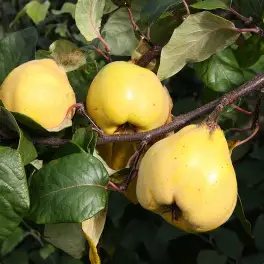
Quince Fruit Tree Seedlings
Quinces are shrubs or small trees up to 4 to 6 metres (13 to 20 feet) tall and 3 to 4.5 metres (10 to 15 feet) wide. Young twigs are covered in a grey down. The leaves are oval, and are downy on the underside. The solitary flowers, produced in late spring after the leaves, are white or pink.
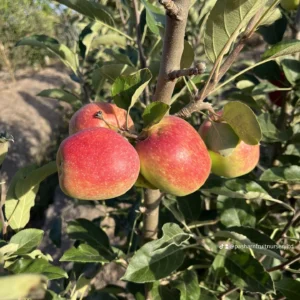
The ripe fruit is aromatic but remains hard; gritty stone cells are dispersed through the flesh.It is larger than many apples, weighing as much as 1 kilogram (2.2 lb), often pear-shaped but sometimes roughly spherical.
The seeds contain nitriles, common in the seeds of the rose family. In the stomach, enzymes or stomach acid or both cause some of the nitriles to be hydrolysed and produce toxic hydrogen cyanide, which is a volatile gas. The seeds are toxic only if eaten in large quantities.
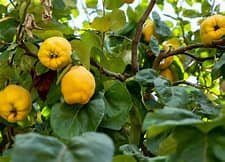
Where to buy quince tree seedlings in Kenya? Pasharn Fruit Nursery Ltd.
KSh 3,000.00
CompareCultivation
Quince is a hardy, drought-tolerant shrub which adapts to many soils of low to medium pH. It tolerates both shade and sun, but sunlight is required to produce larger flowers and ensure fruit ripening. It is a hardy plant that does not require much maintenance, and tolerates years without pruning or major insect and disease problems.
Quince is cultivated on all continents in warm-temperate and temperate climates. It requires a cooler period of the year, with temperatures under 7 °C (45 °F), to flower properly. Propagation is done by cuttings or layering; the former method produces better plants, but they take longer to mature than by the latter. Named cultivars are propagated by cuttings or layers grafted on quince rootstock. Propagation by seed is not used commercially. Quince forms thick bushes, which must be pruned and reduced into a single stem to grow fruit-bearing trees for commercial use. The tree is self-pollinated, but it produces better yields when cross-pollinated.
Fruits are typically left on the tree to ripen fully. In warmer climates, it may become soft to the point of being edible, but additional ripening may be required in cooler climates. They are harvested in late autumn, before first frosts. Quince is used as rootstock for certain pear cultivars.
In Europe, quinces are grown in small amounts; typically one or two quince trees are grown in a mixed orchard with several apples and other fruit trees. In the 18th-century New England colonies, there was always a quince at the lower corner of the vegetable garden, Ann Leighton notes in records of Portsmouth, New Hampshire and Newburyport, Massachusetts. Charlemagne directed that quinces be planted in well-stocked orchards. Quinces in England are first recorded in about 1275, when Edward I had some planted at the Tower of London.
-

 Quince Fruits tree
.jpg)

Pests and disease
Quince is subject to a variety of pest insects including aphids, scale insects, mealybugs, and moth caterpillars such as leafrollers (Tortricidae) and codling moths.
While quince is a hardy shrub, it may develop fungal diseases in hot weather, resulting in premature leaf fall. Quince leaf blight, caused by fungus Diplocarpon mespili, presents a threat in wet summers, causing severe leaf spotting and early defoliation, affecting fruit to a lesser extent. Cedar-quince rust, caused by Gymnosporangium clavipes, requires two hosts to complete its life cycle, one usually a juniper, and the other a member of the Rosaceae. Appearing as red excrescence on various parts of the plant, it may affect quinces grown near junipers.

There are no reviews yet.